There are six atomic-bombed bridges in Hiroshima today. This map highlights five of those bridges.
1 Enko-bashi Bridge (1,820m from the hypocenter)
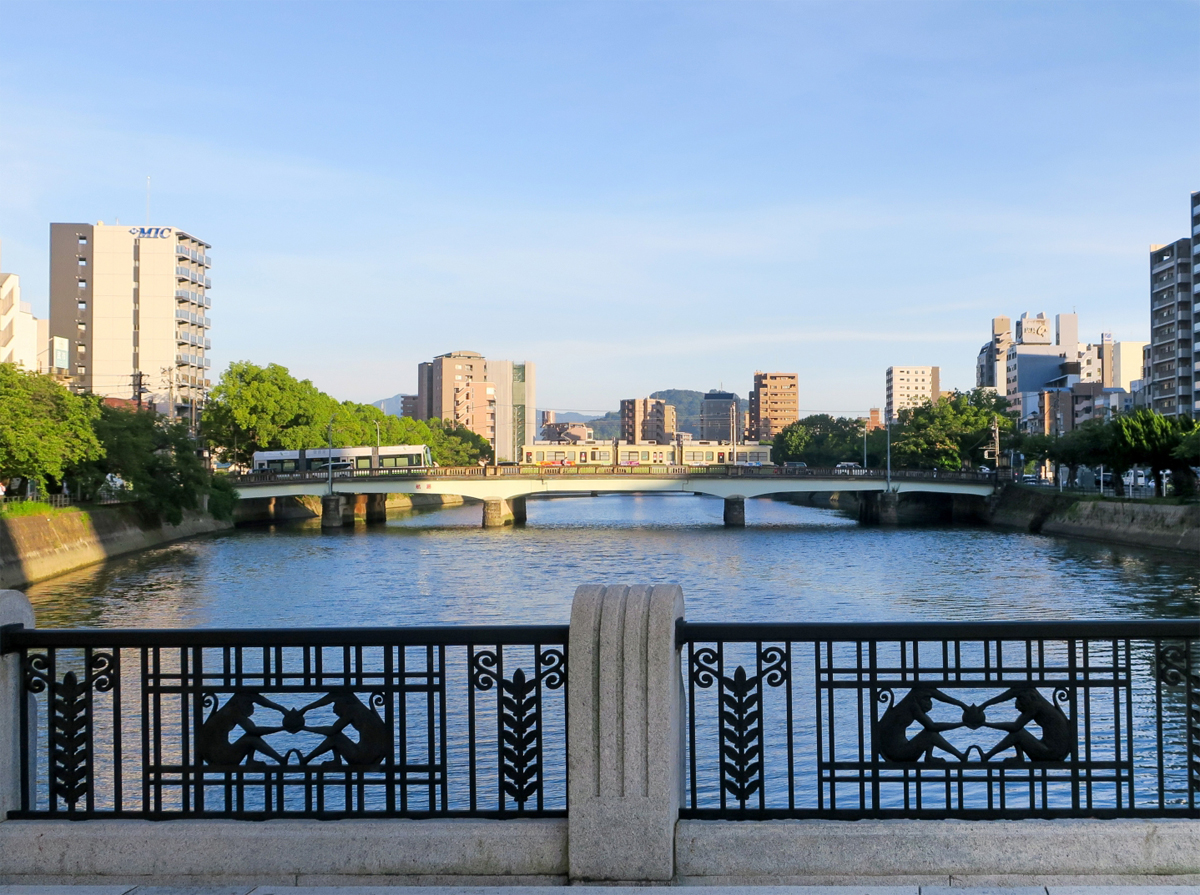
The current Enko-bashi Bridge was built in 1926. “Enko” is an imaginary creature living in the water. When you cross the bridge, please watch out! Be careful not to be caught by an Enko in the river below.
On the main pillars at the four corners, big hawk statues perched on globes. Also, inside the railings, you can find two monkeys facing each other and holding one peach together. During World War II, these metal decorations were taken away and given to the military.
The atomic bombing damaged part of the railings. But the bridge didn’t collapse. Right after the bombing, this bridge was used by fleeing people. The lost decorations were restored in 2016, so we can see its beautiful original style again.
2 Kyo-bashi Bridge (1,380m from the hypocenter)
The current Kyobashi Bridge was built in 1927. It is the closest A-bombed bridge to the hypocenter among all the A-bombed bridges.
The bridge was named Kyobashi because it led to Kyoto from Hiroshima Castle. The original wooden bridge was built in 1591, when Mori Terumoto started building Hiroshima Castle.
It is a steel bridge covered with concrete, harmonizing beautifully with its stone pillars and railings.
In 2011, it was designated as a “Civil Engineering Heritage” site along with the Enko-bashi Bridge because it is a beautiful bridge that survived the bombing.
3 Sakae-bashi Bridge (1,510m from the hypocenter)
The current Sakae-bashi Bridge was built in 1930. It is said that at the moment of the atomic bombing, ghostly flames danced across the bridge. (City of Hiroshima)
The original bridge was built in 1906. One-third of the construction expenses were donated by Eijiro Kumagai, a merchant who supplied goods to the Imperial Army. The bridge was named after the first character of Eijiro, his given name.
Before the bridge was built, a ferry carried people across the river at this location.
Around this bridge, you can find several stone staircases called Gangi. They were important river facilities used to load and unload cargo from boats.
4 Kojin-bashi Bridge (1,910m from the hypocenter)
The current Kojin-bashi Bridge was built in 1939, originally as a tram-only bridge in 1912.
The bridge takes its name from the district of Kojin-machi.
In the 18th century, a great fire burned down the east half of Hiroshima Castle Town. After the fire, the town was renamed Kojin-machi after a local shrine enshrining Sanpo-Kojin, a deity of fire and the kitchen stove.
For over a century, trams crossed this bridge. That long history came to an end on August 2nd, 2025, when the tram route was discontinued.
5 Hijiyama-bashi Bridge (1,710m from the hypocenter)
The current Hijiyama-bashi Bridge was built in 1939, named after Mt. Hijiyama — a hill to the east, despite its grand name.
When the bomb exploded, the hill acted as a natural shield, protecting the area behind it. The blast knocked the railing off the bridge and into the river — but the bridge itself survived, and has been in use ever since.
A 13-year-old boy, Shunichiro Arai, lived just southeast of the hill. I share his atomic bomb experience as an A-bomb Legacy Successor.
.
7.
.